Valentina Duque - Manuela Echeverri
TOPIC: TEACHING AND LEARNING STYLES
Learning models:
- Neuro-Linguistic programming
- Brain hemispheres
- Multiple intelligences
Teaching strategies:
- Multisensory learning
- Direct experience
- Fantasy
Introduction:
In this article the objective is to understand how students learn English through art activities by different styles, that is to say, the learning models, in relation to this, how teachers can know and think in the classroom diversity and personalities, searching a teaching strategies which allow a better developing in the English competence with all types activities that can be valious for each student, achieving a good motivation in the process.
In this order of ideas, it’s important to be clear the reason about arts in this article, because they’re an essential part of the reflexion. In our process as students and teachers we were living different English class experiences, when arts are totally exclude of the learning moment, the process was only focused in the reading and writing skills, becoming the language in a borry and monotonous learning, it could forget the importance to understand and know the needs and interest of the students, so different activities that include every personality and to pay attention to the children likes in the classes, that is to say, the handwork, songs, paintings, manualities, theatre and to allow the imagination to fly.
Now, the invitation is to allow yourself to immerse in another different education world, to think in your students learning models and the ways that you can construct the knowledge by teaching strategies.
- LEARNING MODELS:
Neuro-Linguistic programming:
 Moreover, the basics behind the essential methods and techniques used in Neuro-Linguistic Programming (NLP) are the Representational Systems; or modalities. So, these are basically comprised of the five main senses: visual, auditory, kinesthetic, olfactory (smell); and gustatory (taste).
These modalities think and look the perception of the world which is formed through the senses; and that feelings, memories and behaviours are closely intertwined with these sensory experiences.
Finally, when we behave differently or do things differently we change; both our own reality and our personal world.
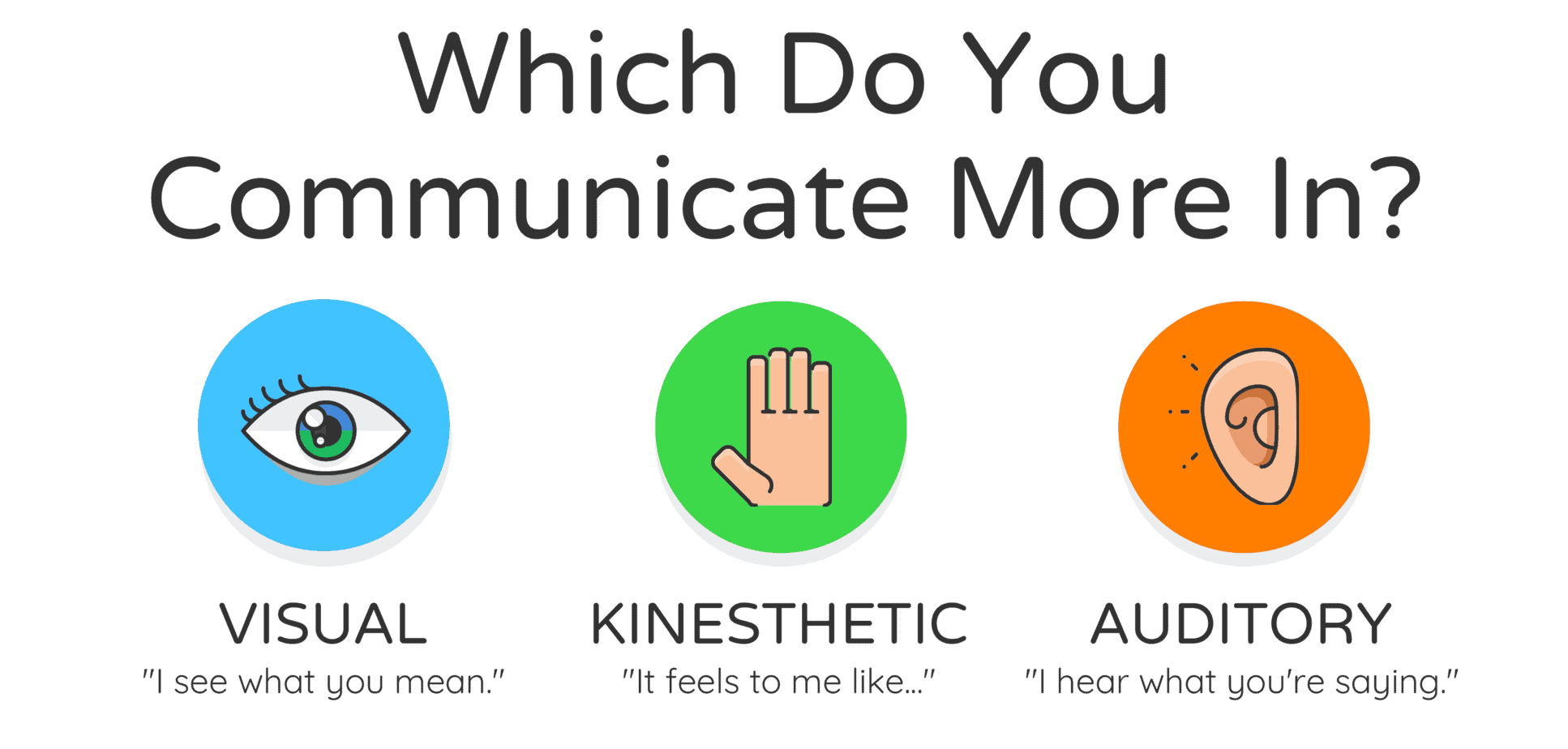
In this part of the magazine, we´re going to talk about three main submodalities used in Neuro-Linguistic Programming (NLP), such as visual, auditory and kinesthetic.

VISUAL:
When we are in Visual Modality; the information is being kept and processed through images. Such pictures are like memories kept in the mind with any associated feelings and value judgments attached to them.
- Speech Rate: When in visual mode speech tends to be fast. People in visual mode tend to speak quickly. And in a higher tone. If you think about trying to explain a beautiful scene, language is very limiting and slow compared to the visual aspect.
- Body language: People in visual mode use a lot of hand gestures and often sit upright on the edge of the seat.
- Eye Clues: When using visual modality people look up a lot especially to the left. Sometimes people in visual mode have day dreamings.
- Language: People with visual modality will use and respond to language relating to sight and images, using the next examples in their opinions:
Do you see what I mean?
I can picture that.
Look at this from my point of view
Imagine the scene (seen)
AUDITORY:
In the auditory mode information is processed through sounds. People operating in this modality will often talk to themselves (a lot). In addition, those in auditory modality may move their lips whilst reading or thinking. Auditory thinkers are easily distracted by noise. But can easily follow verbal instructions.
A classic auditory mode example is just how evocative a tune from our past can be. An unexpected song or tune can bring back all sorts of memories and feelings totally out of the blue.
- Speech rate: Medium; but often tends to be quite rhythmic.
- Eye Clues: Side to side eye movements (as if looking at the ears).
- Language: Will use and respond to language relating to sound – look out for:
Do you hear what I’m saying?
I like the sound of that idea
Now you’re talking my language
I hear from you.
You’re not listening to me!
KINESTHETIC:
In the Kinesthetic modality, information is processed through movement and touch. The learning style in this mode involves actually ‘doing’ something, such as moving or touching.
- Breathing: from the bottom of the lungs
- Speech rate: Slow and deeper voice
- Eye Clues: Eyes bottom left
- Body language: Few hand gestures. Responds well to touch and physical rewards
- Language:
I want to get to grips with that
Let’s give it a go
I have a firm foundation in ….
I feel we may do well if ….
2. BRAIN HEMISPHERES:
The brain is a remarkably complex organ composed of billions of interconnected neurons and glia. It is a bilateral, or two-sided, structure that can be separated into distinct lobes. Each lobe is associated with certain types of functions, but, ultimately, all of the areas of the brain interact with one another to provide the foundation for our thoughts and behaviors. There are four lobes in each half of the brain: the Frontal Lobe, Temporal Lobe, Parietal Lobe, and Occipital Lobe. Other important sections of the brain are the Cerebellum and the Brain Stem.
Brain anatomy is very interesting with the specific differences between the right and left side. For instance, a part of the brain called the lateral sulcus generally is longer in the left hemisphere than in the right hemisphere, but scientists do not always see any functional differences. If a specific area of the brain is injured, its functions sometimes can be assumed by another area of the brain. This is a very unique function of the brain.
It can be said that the spinal cord is what connects the brain to the outside world. Because of it, the brain can act. The spinal cord is like a relay station, but a very smart one. It not only routes messages to and from the brain, but it also has its own system of automatic processes, called reflexes.

 The Right Brain: The right hemisphere of our brain excels in visual perception, understanding spatial relationships, recognizing patterns, music, emotional expressions, etc. It is also good at making inferences. Also the right hemisphere is best at expressive and creative tasks. For example, when primed with words such as “foot”, “cry” and “glass”, our right hemisphere will relate these words to “cut”. Our right hemisphere also lets us perceive the sense of self. People with lesions in the right brain sometimes have difficulty recognizing themselves in the mirror.
 The Left Brain: The left hemisphere of our brain handles tasks such as reading, writing, speaking, arithmetic reasoning and understanding. Study shows that when we speak or do arithmetic calculations, activity increases in our left hemisphere. Another characteristics of our left hemisphere is that it tends to process information sequentially, one at a time.
Careers for Right and Left-Brained People
https://www.psychologynoteshq.com/brainhemispheres/
3.MULTIPLE INTELLIGENCES:
 The principle known theories are applicable in each classroom depending of the interests, needs and opinion of the students and teachers, but, the multiple intelligences theory looks these like a traditional psychometric views of intelligence and they are too limited. “Gardner first outlined his theory in his 1983 book "Frames of Mind: The Theory of Multiple Intelligences," where he suggested that all people have different kinds of "intelligences." Gardner proposed that there are eight intelligences, and has suggested the possible addition of a ninth known as "existentialist intelligence."
In order to capture the full range of abilities and talents that people possess, Gardner theorizes that people do not have just an intellectual capacity, but have many kinds of intelligence, including musical, interpersonal, spatial-visual, and linguistic intelligences.
While a person might be particularly strong in a specific area, such as musical intelligence, he or she most likely possesses a range of abilities. For example, an individual might be strong in verbal, musical, and naturalistic intelligence.”
Criticism
“Gardner’s theory has come under criticism from both psychologists and educators. These critics argue that Gardner’s definition of intelligence is too broad and that his eight different "intelligences" simply represent talents, personality traits, and abilities. Gardner’s theory also suffers from a lack of supporting empirical research.
Despite this, the theory of multiple intelligences enjoys considerable popularity with educators. Many teachers utilize multiple intelligences in their teaching philosophies and work to integrate Gardner’s theory into the classroom.
Learning more about the multiple intelligences can help you better understand your own strengths.” Next you will look a general view about the eight multiple intelligences:
TEACHING STRATEGIES
Education word has a lot of changes which bring
to teachers a constant challenge for knowing, understanding and analyzing the
context and each student’s individual process, because the needs and interest
have to be present in every class activity. Usually, the planning moment is
decontextualized for students and also, teachers, doing a several of elements
to comply with the request of the government, but, when do teachers do an stop,
reflect about their own learning and how is the best way to understand the
concepts? Currently, it’s important building a personal analyzing and make a
planneating according to teachers, students, context and subject, taking into
account each learning rhythms and ways to teach.
Hereby, investigation was done to present you
three strategist to use in your classroom or any formation space, with the
purpose of focus teaching on each student process and their closest way of
learning, building interest and love for diverse education.
- Multisensory
learning:
How to teach a topic relating all the senses of the
students?
What benefits does this have for the learning process?
Teaching is usually based
on strengthening the listening and sometimes the vision, in order to prepare
the student for a positive future, but what about his/her present? For a
meaningful teaching, it’s necessary to think of a process that relates all the
senses of the student, that allows him to realize the concepts with his body,
for those kinesthetics, also something which has visual elements and in turn,
integrate hearing and taste, because, who learn something without experience?
This is the challenge of education, learning to see students as complete
beings, with potentialized skills in a specific element but with the need to
strengthen each of them.
In this order of ideas,
it’s necessary to go back a little time and analyze the reasons of this
teaching strategie, in “Western culture, we tend to consider mind and body as
separate entities, assigning thought to mind and action and sensation to the
body. However, the sensory and motor systems are part of both the brain and the
body, and their proper development is a prerequisite for good cognitive
functioning”. (Anonymous, 2006, p. 75). The senses are the form which we
understand the world, we can reflect and analyze each aspect around us because
we join all the senses of our body and they give us the possibility to develop the
abstract thinking, an important element for a foreign language teaching
process, an example is for “children who have difficulties with reading, such
as dyslexia, the use of sight, hearing, movement and touch can help them learn”
(Rodríguez, 2017, p.1)
Here, there are three
types of senses which usually are forgotten in classes.
|
SENSE
|
MEANING
|
LEARNING
|
|
Kinesthetic and tactile learning
|
These two senses are
related but don’t always occur at the same time. It allows students to
experience learning with their body and see the world from another point of
view, as well, it helps improve concentration and motivation, especially for
children with a disorder, such as attention deficit and hyperactivity
disorder.
In theoretical words,
“the touch system depends on receptors on the skin. The kinesthetic system
records the movement; its receptors in the muscles and tendons provide
information about body movement” (Anonymous, 2006., p.79).
|
In school, we find
many students with different skills, it’s important to analyze their closest
way of learning the concepts without leaving them at a disadvantage with the
other visual and auditory. This is why we should think about classes for
kinesthetic students too, who learn through their body, playing, moving,
whether through play, dance, gesture or theater.
|
|
Smell and taste learning
|
“The smell is a
remarkable stimulus for memory and a key to achieving rich associations of
experience and emotion”. (Anonymous, 2006, p.79). In this order of ideas,
teachers must be attentive to each significant characteristic that our
students show in order to think a class for them, where their learning is the
center of each activity and these are consistent with their affinity, in this
case, the smell and taste, a more real process of object recognition.
|
Learning can begin its
path from the covering of the other senses, making the student can use only
smell and taste, even touch, to identify, describe and organize certain
elements.
|
|
Nonverbal auditory learning
|
Learning process has a
big transformation each day, because we aren’t working with static objects,
our labor is with human beings, who think and analyze their context
constantly and use another ways to understand the knowledge, in this case,
the nonverbal auditory learning, where music is a good friend to visualize
the word with other perspectives. So, “music is part of every historical
period, and its inclusion in a history class provides an additional dimension”
(Anonymous, 2006, p.79).
|
Music is a important
form to learn, it allows students seeing the world with a different eyes, a
example is to use the baroque and classical music to compare and analyze two
times of the history, and understand with more details the culture of both,
this learning is kept in the mind of them for a long time, because it’s
related with their interests.
|
|
Proposed activity:
Introduction: Reading a story with movements as an
introduction to the theme to work (Healthy eating - farm food).
·
In
groups, teacher will give to each one a specific food, they have to think how
is the machine which produces it and organize the form to do it with their
bodies (kinesthetic and tactile learning).
·
Then,
each group will present the machines twice, while the opposing group must:
Listen: Without observing.
Vision: No sounds
·
Finally,
each group will taste the food produced by the other equipment's machine.
What is the product that the group machine was producing? Match
the answers of each table space and find a final answer.
The table should be completed as activities are developed, that
is to say, they have to write what food they think is it in kinesthetic,
listening, visual and taste presentation of the other group.
|
- Direct
experience:
How to teach from the context of the students and a
real interaction with their environment?
What benefits does this have for the learning process?
Current education
requires a broader relationship with the context surrounding the student, when
we focus knowledge on their real experience it is possible to understand the
concepts more meaningfully and integrate their interests and needs into it.
Direct experience is a teaching strategy that enables the development of
creativity, stimulates thinking and involves the student in their own learning
process. “Experiential learning stimulates original thinking and creates a wide
range of thinking strategies and perceptual skills, which aren’t reached
through books or simple explanations”. (Quintana, 2018, p.3).
In this sense, this
strategy is related with some learning styles as Kolb Model, Multiple
Intelligence Model and Brain Quadrant Model and it allows to improve the
interpersonal abilities with some activities, for example, visit a museum,
laboratory or see the process of a growing plant. As Quintana (2018) said, “the
types of teaching experiences described have the power to demand a place in
memory, not only because they’re fun, but they encourage students to think and
create meanings on their own. This kind of mental challenge is pleasant;
increase self-esteem and turn learning into a revitalizing activity” (p.3).
|
Teacher real experience:
“The
teaching of the natural sciences can be understood in relation to the foreign
language, creating a balance between the two processes and allowing the
student a unified learning process. When I was on the subject of the
ecosystem, I decided that my students lived how is analyze one of these and
identify its elements, so we were in a green area, where with various
materials such as sticks, tape and magnifying glass, they had to separate a
small ecosystem and observe several aspects that I suggested them, in this
way, even the concept of the food chain was built by themselves, feeling real
knowledge and close to them.
Manuela Echeverri.
Elementary school teacher.
|
- Fantasy:
How to teach integrating the motivation, imagination and
innovation of students?
What benefits does this have for the learning process?
When we talk about the
left hemisphere, we find several aspects which are located in traditional
education in schools, it’s important to create a balance between both, but in
this case, fantasy allows us to locate ourselves in the right hemisphere,
paying attention to all students who prefer a learning method close to their
imagination. In this order of ideas, “fantasy is a door to our inner world,
that "magical" realm where imagination creates its own realities
without being hindered by the limitations we encounter in the outside world.
Time and space pose no problem to the mind. It can allow us to be and do
everything the mind can conceive”. (Anonymous, 2006, p.66).
The innovation process
is an element that we must integrate into classrooms today, due to the need of
new generations to express their ideas in different ways, this is how, when
teachers allow a space of socialization, where imagination is the central
aspect, the learning begins to be located in relation to the interests of the
child, his motivation increases and it’s allowed the construction of new
possible worlds, taking his learning to a level of understanding, which will be
conscious and not mechanical.
It’s important to take
into account some requirements to integrate this strategy in classrooms, the
teachers in this are guides that allow the construction of unusual moments of
each component, in order to understand fantasy as an increasingly recurring
element . Most of the time, we must begin its introduction from a space of
relaxation, in order to "block the verbalization of the left hemisphere so
that the right can begin to be hear" (Quintana, 2018, p.1) The noise from
outside is part of our day to day, this is how teacher's challenge is to give
the student a chance to build their own world and in turn, the desired
knowledge from their imagination.
The power of fantasy is to offer the fruits of
the right hemisphere's thinking, and thereby provide us with resources on both
sides of the brain. If you ask students to think of a name, they will respond
with information from the left hemisphere. If you ask them to become a name and
say what sensation they experience, they will look for perceptions of the right
hemisphere (Anonymous, 2006, p.66).
In this sense, after the
moment of relaxation you should analyze what kind of fantasy you want to work
in the classroom, observation or identification, being the first simply focused
on a process of reviewing information or material presentation, and the second
as a more complex and complete process, in which the student has the
possibility of being the concept that is being worked, feeling this and
appropriating the role that was given. Shyness is a common element in these
types of activities, but we must identify strategies that enable meaningful
work, either covering the eyes at the beginning or individually and then
socially, with more confidence.
|
Teacher real experience:
“Literature
has been my best friend during the process of knowing my students, through it
I have opened spaces for socialization, with it I strengthen students'
imagination and allow them to learn from their interests and needs, letting
their ideas fly and putting in the form of drawing, writing, body or verbal
representation everything they have built from the recognition of imagination
and motivation as essential elements within the classroom. I use fantasy when
there is a complicated group at the level of behavior, when I see that they
need to change the routine or simply, so that they better understand a topic
worked and don’t forget it.”
Nora Liliana González
Elementary school teacher.
|
REFERENCES
Damaris, Q., 2018. Teaching strategies.
Material autoinstruccional
para docentes y orientadores educativos, 2006. Manuela de estilos de
aprendizaje.
Rodríguez, A., 2017.
Multisensorial teaching. Fundación QUERER.


No hay comentarios:
Publicar un comentario